

VALIDATION & VERIFICATION

WHAT ARE
VALIDATION &
VERIFICATION BODIES?
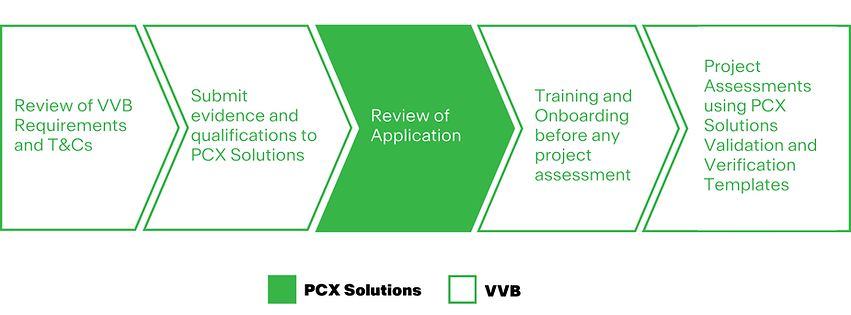
Validation and Verification Body (VVB) refers to a third-party organization, independent from PCX Solutions and the Project Partner, that has been approved by PCX Solutions to carry out validation and verification of Projects to evaluate conformity with the PPRS.


.png)


HOW TO QUALIFY
AS A VVB?
Requirement/ Competency Area
Core Focus & Verification Criteria
PPRS
AMC
Evidence
Accreditation & Organizational Competence
ISO/IEC 17021 or 17029 accreditation (or SA8000® for PPRS) by an IAF/SAAS member, or equivalent demonstrated experience in conformity assessment.

1. ISO Accreditation Certificate & Schedule: Copy of valid accreditation under ISO/IEC 17029 or ISO/IEC 17021 (or SA8000®) issued by an IAF-member National Accreditation Body (e.g., DAkkS, UKAS, ANAB)
2. Sectoral Scope Schedule: Official schedule showing approved scopes in relevant areas (e.g., chemical manufacturing, waste management, or environmental auditing).
Legal & Administrative Compliance
Confirmation of legal entity status to operate within target jurisdictions and signed confidentiality/terms agreements.
1. Certificate of Incorporation, Business License or Permit
2. Signed VVB Application Terms and Conditions
Environmental & Social Auditing Experience
Proven track record in environmental and/or social auditing, including independent assessment of sustainability projects.
E&S Audit Log: Anonymized audit log demonstrating direct field experience auditing projects in accordance with International E&S Frameworks and Safeguards
Waste Management & Circularity Systems
Expertise in waste management systems, plastic value chains, waste streams, and evaluating the Waste Management Hierarchy.
Auditing Life Cycle Assessments (LCAs), Cradle-to-Cradle (C2C) metrics, and evaluating potential burden-shifting (land, water, energy).
Provide at least one of the following:
1. LCA / Environmental Assessment Credentials:
CVs or certificates showing experience evaluating Life Cycle Assessments (LCAs), environmental proxy matrices, or ISO 14040/14044 standards; or
2. Waste Systems Auditing Log:
Anonymized audit log demonstrating direct field experience auditing waste management facilities, sorting centers, mechanical recyclers, or industrial composting plants.
Material Science & Chemical Safety
Mass-Balance & Supply Chain Accounting
Evaluation of polymer specs, voluntary certification schemes (ISCC PLUS, RSB, RSPO, FSC), compostability/recyclability standards (EN 13432, ASTM D6400), and chemical/food-contact safety (NIAS, restricted lists).
Mass reconciliation, net mass vs. unrecoverable waste auditing (production scrap, leakage), and cross-supply chain data reconciliation to prevent double-counting.
Primary Evidence:
1. Auditor qualification matrix / CVs:
CVs for assigned Lead Auditors/Technical Experts demonstrating degrees or formal training in Polymer Chemistry, Materials Science, Chemical Engineering, or Packaging Technology.
Supporting Technical Proof (at least one of the following):
1. Audit log of technical experience: Anonymized list/log of past audits involving bio-plastics, packaging materials, or food-contact materials (FCM).
2. Trainings / Certifications: Proof of completion of relevant industry training (e.g., EU Food Contact Material regulations, REACH/RoHS compliance auditing).
Chain of Custody (CoC) audit records:
Evidence of auditing bookkeeping systems, physical vs. allocated inventory, yield loss ratios, credit ledgers, and conversion rates under ISO 22095 principles and/or prior audit experience verifying Mass-Balance systems (e.g., Lead Auditor credentials or audit logs for ISCC PLUS, REDcert, FSC, PEFC, or RSPO).
Financial & Commercial Auditing
Verification of price premiums (ΔP), procurement contracts, operational expenditure (OpEx), and downstream sales revenue deductions.
Provide at least one of the following:
1. Financial Auditor Credentials:
Proof that the audit team includes at least one member with recognized financial/commercial auditing qualifications (e.g., CPA, ACCA, Chartered Accountant, or ISO 9001 Financial Auditor); or
2. Commercial verification experience log: Summary of past engagements involving commercial invoice testing, financial OpEx verification, supply contract review, or pricing index auditing (e.g., via GHG/carbon assurance, supply chain, or financial auditing).

.png)