
How to Unlock Capital for a Circular Plastics Economy in ASEAN

Updated: 5 days ago

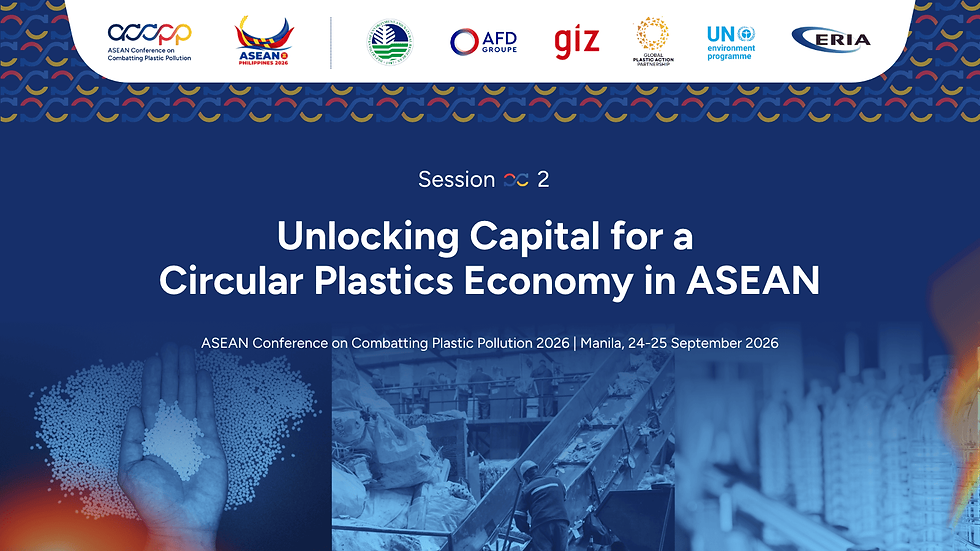
PCX Solutions was honored to contribute to the session "Unlocking Capital for a Circular Plastics Economy in ASEAN" at the ASEAN Conference on Combating Plastic Pollution 2026 on 24 September 2026.
The session examined strategies for mobilizing public, private, and catalytic finance to support a circular plastics economy in ASEAN considering two crucial dimensions:
The scale of the problem - ASEAN generates approximately 24,500 kilotonnes of plastic waste with only a fraction properly managed and an estimated 3,500 kt leaking to the environment each year.
The tremendous financing gap - ASEAN region will need to mobilize US$178 billion in strategic investments to effectively fix plastic leakage and overhaul waste management infrastructure by mid-century.*
With ambitious policies, regional cooperation, and targeted investments, the region could eliminate up to 95% of plastic leakage by 2050. Closing the financing gap is foundational to that ambition.
To attract and deploy capital at scale, ASEAN needs economic factors such as increased feedstock supply and quality, clear demand signals and price competitiveness for recycled plastics, expanded collection and recycling infrastructure, improved project pipeline and readiness, policy clarity, and risk-sharing frameworks. While these aspects are slowly being addressed, the plastic crisis demands urgent action.
Plastic credits are one proven solution to complement other financing tools, and they are readily available. They can help fund the "middle segment" of the plastic waste value chain—such as aggregators and sorters—which are frequently classified as "unbankable." Additionally, plastic credits serve to de-risk capital investments and support ongoing operational expenditures while ensuring compliance with environmental and social safeguards. Even in scenarios where capital expenditure (CapEx) financing is secured, operational expenditure (OpEx) funding often remains a key constraint.
Under the Plastic Pollution Reduction Standard (PPRS), one credit is one metric ton of plastic waste that has been collected, transported and then brought to end-of-waste destinations (excluding landfills). A robust framework ensures project integrity: projects must undergo a formal conformity assessment by an independent third-party auditor for compliance against all standard requirements. Furthermore, each transaction is verified by a separate independent impact auditor, establishing a complete end-to-end chain of custody and full traceability. Subsequently, all transaction details are published on a public registry, including specifying whether the credits were issued under voluntary or mandatory compliance frameworks
Plastic credits can be fully integrated into Extended Producer Responsibility (EPR) schemes, as demonstrated in the Philippines, where they serve as one recognized compliance mechanism. This framework enabled capital to flow into waste management infrastructure from day one. Plastic credits can also facilitate the transition toward formal EPR regulations within voluntary Producer Responsibility Organization (PRO) frameworks. Lastly they offer a structured mechanism for nations and companies in the Global North to assume responsibility for legacy plastic waste, addressing decades of plastic exports to the Global South where adequate processing infrastructure was lacking.
But credits must follow rigorous standards to ensure credibility, transparency and accountability.

From a broader perspective, the discussion addressed key investment barriers, evaluated other financial frameworks such as EPR fees and blended finance mechanisms, and explored strategies to strengthen regional coordination while leveraging national initiatives, including the Philippines' National Plastics Roadmap.
Key session objectives included:
Identifying investment barriers, gaps, and opportunities within the regional plastics value chain.
Evaluating innovative financing mechanisms, such as blended finance, green bonds, plastic credits, EPR revenues, and fiscal incentives.
Analyzing enabling regulatory environments to de-risk investments, including recycled content mandates and trade facilitation.
Exploring regional coordination approaches—such as harmonized standards and ASEAN Trade in Goods Agreement (ATIGA) anchored measures—to unlock capital at scale.
Examining the Philippines' National Plastics Roadmap as an actionable financing model requiring cross-sector coordination across government, industry, and financiers.
Speakers of the session:
Mr. Michael Watters, Economic and Climate Counsellor, British Embassy Manila
Hon. Jonas R. Leones, Undersecretary for Policy, Planning and International Affairs, Department of Environment and Natural Resources (DENR)
Mr. Christophe Bahuet, Resident Representative, United Nations Development Programme (UNDP) Philippines
Ms. Christine P. Chan, Principal Urban Development Specialist, Asian Development Bank (ADB)
Ms. Cristina Cabalza, Executive Director, The Coca-Cola Foundation Philippines
Ms. Stefanie Beitien, Managing Director and Board Member, PCX Solutions
Ms. Stephanie Sabhanindita, Senior Business Sustainability Manager, Southeast Asia/ANZ, Packaging and Specialty Plastics, Dow
Moderation by Ms. Roisin Greene, Head of Strategy, Growth and Partnerships, and Ms. Shreya Anand, Circularity Programming and Engagement Specialist, World Economic Forum
More info about the ACCPP here.
Since its inception in 2023, the ACCPP has been held annually under the patronage of the incumbent ASEAN Chair, serving as a platform for stakeholders to strengthen regional collaboration, share the latest developments, and identify actionable solutions towards a sustainable plastics economy.
The 2026 conference was convened by the Department of Environment and Natural Resources (DENR) of the Government of the Philippines, co-hosted by the Economic Research Institute for ASEAN and East Asia (ERIA), and supported by Agence Française De Développement (AFD), Deutsche Gesellschaft für Internationale Zusammenarbeit (GIZ) GmbH, the Global Plastic Action Partnership (GPAP) of the World Economic Forum, and the United Nations Environment Programme (UNEP).

*Source: OECD (2025), Regional Plastics Outlook for Southeast and East Asia, OECD Publishing, Paris, https://doi.org/10.1787/5a8ff43c-en


Comments